Saturday, March 28, 2020

"Unlikely Allies" by Chuck Oshaben: A story about crows and young pigeons


This article was published in Racing Pigeon Digest, Vol. 28, No. 20, March 15, 2020.  It appears here courtesy of the author, Chuck Oshaben, and the Editor/Publisher of Racing Pigeon Digest, Gene Yoes.  You can send correspondence for Mr. Oshaben to chuckoshaben@gmail.com and for Racing Pigeon Digest to pigeondigest@gmail.com.

The question people ask me most often about the war pigeons is, “How did they find their way back?”  Chuck’s story gives us a look into the bird world. His story is a testament to birds’ intelligence and to how well they understand us and therefore it offers some insight into why the war pigeons would risk their lives over and over again to deliver messages for their human friends.  

The pages are depicted in two sizes.  For the larger size you can use the scroll bar at the bottom to move the page into full view.


Sunday, March 15, 2020

Middle East Breeding Centre and School, 50 pigeons needed at Aden,1943, and talk about Enigma by Dermot Turing, 2020

Royal Air Force Operations in Middle East and North Africa, 1940-43
Armoured cars and vehicles rest on the track between Lahej and Musemir in the mountains of Southern Arabia, during a reconnaissance patrol by the RAF Armoured Car Section, based at Khormaksar, Aden.  Photo taken by RAF Official Photographer.  Imperial War Museum  © IWM (CM 5249)

(c) Crown copyright images reproduced by courtesy of The National Archives, Kew, UK
Catalog numbers:  AIR23/998  #138, #139, #144

On February 13, 2020, Alan Turing’s nephew, Dermot Turing, gave a talk about his latest book X, Y and Z, The Real Story of How Enigma Was Broken at the International Spy Museum.  You can listen to the talk on the C Span 3 website.  Search Dermot Turing in the search box near the top of the home page.  This will take you to the page where you can click on the blue play button next to “Breaking the German Enigma Code.”  The talk includes questions and is about 98 minutes long. Turing does an excellent job of giving the Poles the credit they deserve for their contribution to breaking Enigma.  Sadly, the talk was given on the 90th anniversary of the death of Christopher Morcom, Alan Turing’s brilliant and inspirational friend. They met in 1928 at Sherborne School.  Christopher died unexpectedly on February 13, 1930.  To learn more about their friendship, check out the documentary Codebreaker releasd in 2012.
Below is a link to the talk:


Sunday, March 8, 2020

50 lofts needed in East Africa and Pigeon Loft 271 to serve Bombers USAAF, 1943

(c) Crown copyright images reproduced by courtesy of The National Archives, Kew, UK
Catalog numbers:  AIR23/998
#121, #122, #123, #134, #135, #136, #132, #131, #130, #128, #124

NOTE:  Yesterday, March 7, marks the 75th anniversary of the Allied capture of the Ludendorf Bridge across the Rhine.  For an account of this operation, check out “Hitler’s Last Bridge,” an episode of the TV documentary World War II’s Greatest Raids, produced in 2014.


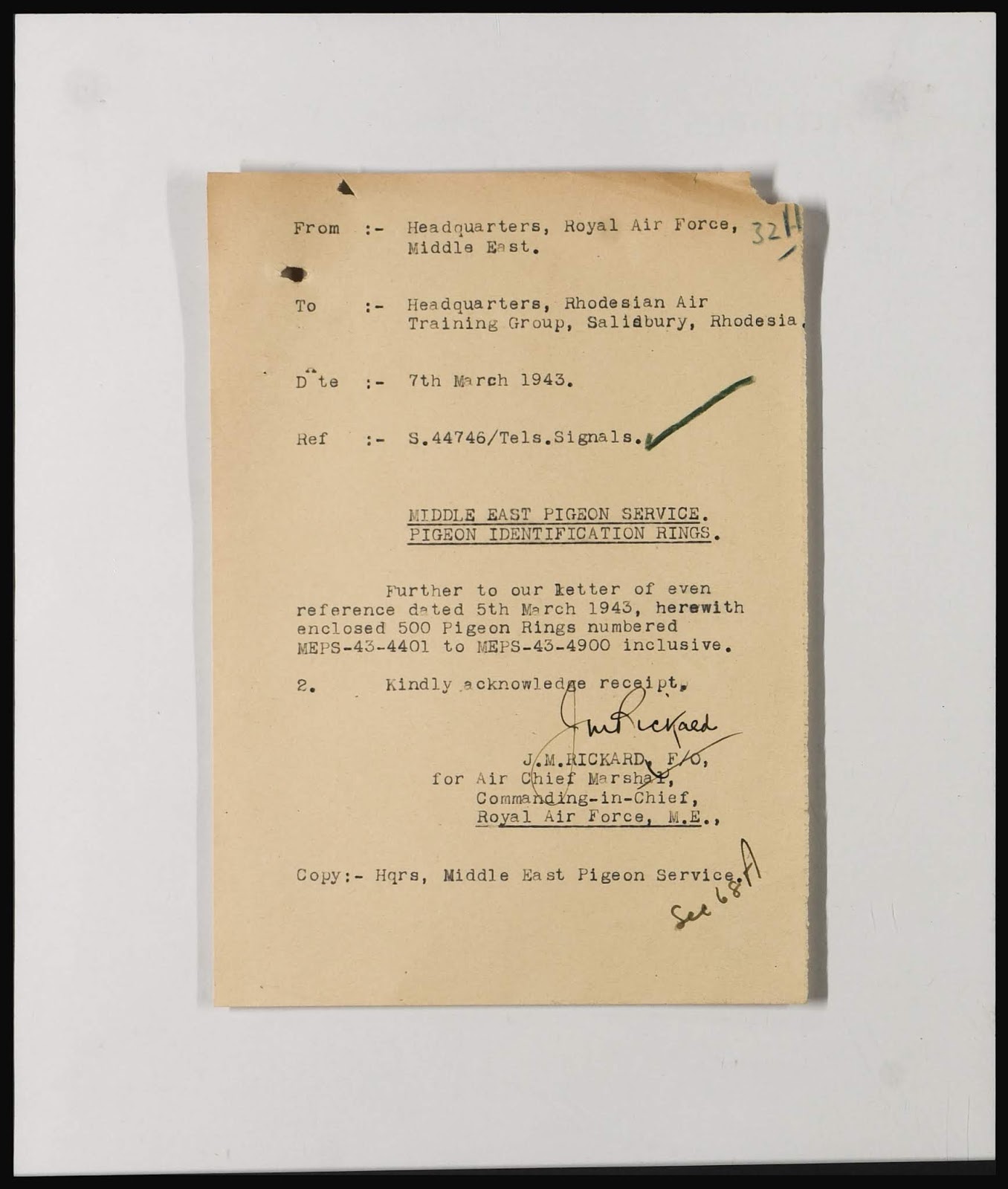
Supply of Pigeons from South Africa and Establishment of Lofts for Middle East Pigeon Service, Jan-Mar 1943

The Royal Air Force East Africa Command, 1940-45
Bombs explode among Italian Caproni Ca 133s on 'K14' satellite landing ground at Assab, Ethiopia, during a raid by Bristol Blenheim Mark Is of Nos. 8 and 39 Squadrons RAF, based at Khormaksar and Sheikh Othman, (respectively), Aden. Three Ca 133s were destroyed and one damaged.  Photo by No. 8 Squadron RAF.  Imperial War Museum  © IWM (CM 2)
No date available for photo

(c) Crown copyright images reproduced by courtesy of The National Archives, Kew, UK
Catalog numbers in the order in which they appear:  AIR23/998
#118, #119, #120, #116, #110, #111, #112, #113


Tuesday, January 14, 2020

Construction of sectional lofts at Benghazi and Tripoli, March 1943

The Second World War 1939-45: North Africa
A member of a British light anti-aircraft gun crew in Benghazi looking for enemy bombers. He is wearing an Italian hat which he secured as a souvenir.  Photo by Sergeant Palmer.  Imperial War Museum © IWM (E 20024)

(c) Crown copyright images reproduced by courtesy of The National Archives, Kew, UK
Catalog number:  AIR23/998  #90

The City of Tripoli
A Bofors gunner on the alert for enemy air raiders in the harbour at Tripoli. The ship in the harbour has been torpedoed but has not sunk, January 1943.  Photo by No. 1 Army Film and Photographic Unit.  Imperial War Museum © IWM (E 21909)


Saturday, December 28, 2019

Expansion of Breeding in Middle East Pigeon Service, March 1943


Excerpt from “Loft Manager and Pigeons,” by Bert Braspenning, Holland, in Racing Pigeon Digest, October 15, 2019:

     “When the last middle distance races start you can see the number of participating pigeons run back quickly.  This is because many fanciers who no longer have a chance at a championship will focus on the young pigeon game….A lot is being demanded of the young pigeons while they have to work in the toughest period of the season.  Often very hot and that is not an easy task for not well-trained youngsters.  This year and last year the juniors have a very difficult time.
     Still I look forward with interest to the remaining races.  The young pigeons are increasingly forming pairs, are cuddling somewhere in corners.  Others already have eggs and a couple gave birth to the first youngster two days ago.”


(c) Crown copyright images reproduced by courtesy of The National Archives, Kew, UK
Catalog number:  AIR23/998  #89


Wednesday, December 25, 2019

US Army Signal Pigeon Companies Manuals


Many thanks to Richard Fowler for contributing these links to the manuals.


TM 11—410, THE HOMING PIGEON, 1 January 1945


FM 11-80 Pigeon Signal Company Sept 15, 1944

https://archive.org/details/FM11-8


"Pigeon Communication" FM 24-5 Basic Field Manual Signal Communication, Oct. 19, 1942


(1943) Pigeon Training Section, Preventative Veterinary Medicine,      Signal Corps, 88pp
 https://babel.hathitrust.org/cgi/pt?id=coo.31924000932164&view=2up&seq=2

 (1940)  TM 11—410, THE HOMING PIGEON, 10 September 1940, 72pp
 https://archive.org/details/TM11-410

  (1936)  TR 1255-1 The Homing Pigeon,  30 October 1936, 33 pp
  https://books.google.com/books?id=-9wsAAAAIAAJ&pg=PA1

  (1931) Ch 9, Pigeon Loft Management, Signal Corps field manual,  Volume II, Signal Corps Operations, pp134-147
  https://babel.hathitrust.org/cgi/pt?id=uc1.$b630685&view=2up&seq=146

  (1931) "Pigeons at message centers", Basic Field Manual, Vol IV, Signal Communication, 1931, 12pp chapter
  https://books.google.com/books?id=VVAsbIoCRNgC&pg=PA248&dq=pigeons

  (1923) The pigeoneer. Training Manual No. 32, Students manual for all arms,  15 August 1923, 164pp
  https://books.google.com/books?id=yyhDAAAAYAAJ
  https://babel.hathitrust.org/cgi/pt?id=coo.31924000069231&view=2up&seq=6

  (1923) Message Center Specialist. Training Manual No. 24, Students manual for all arms, 28 June 1923, pp 46-64
  https://babel.hathitrust.org/cgi/pt?id=njp.32101072897109&view=2up&seq=712

(1920)  Homing Pigeon, Care and Training for Military Purposes, February, 1920, 60 pp
https://books.google.com/books?id=Z8UtAAAAIAAJ

This one is a British manual:

 (1919) "Pigeon Service Manual", Air Ministry, June 1919, 17pp
 https://vassallohistory.files.wordpress.com/2014/03/raf-pigeon-service-manual1.pdf