Saturday, May 9, 2020

Gordon H. Hayes photos: more photos added 5/9/20


The photos below come from the Gordon H. Hayes Collection, catalog number MSS294, held by the Holt-Atherton Special Collections Department at the University of the Pacific Library.  Used by permission.  You can request reproductions of other materials in the Gordon H. Hayes Collection by contacting librarian Nicole Grady, ngrady@pacific.edu.

Gordon H. Hayes is the author of The Pigeons That Went to War.  He served as a pigeoneer in Africa and Italy during World War II.

The newly added photos start after the first photo of the British pigeons.

French pigeons


British pigeons, photo by Hayes


Hayes's caption reads:  "Looking at a wak weary B-24."


This looks like it says Gen. Clark and Ike.


Sgt. Sylvester Sobecke prepares pigeons for parachute drops to isolated units behind German lines.  The crate holds eight pigeons.  Sessa front, Italy.
Capt. Dave Buscall, Jr. being decorated with the silver star by General George Patton, Jr. for his daring rescue of three pigeoneers at Gafsa, Tunisia.

American combat mobile loft, feeding time.


In camp


Time with pigeons

Sidney Ober, the trainer of Miss Ober, packing a combat crate of four pigeons, for use by the Infantry Patrol at the front.  Terracina, Italy.


Not labeled

Not labeled

Jim Ginnell banding squabs at the breeding base, Bizerte, Tunisia.  The squabs were banded at ten days old.

Not labeled

Price Day, War Correspondent of the Baltimore Sun, using a pigeon at the Cassino front.


Not labeled


Red Bronson, driver of the Bronx Express, one of our combat mobiles, north of Florence, Italy.

Racing Pigeons donated by civilian fanciers awaiting shipment overseas.  Fort Geo. Meade, Maryland.


Not labeled


Cpl. Leonard Karnopp, who produced many superb war pigeons, standing in his breeding loft at Bizerte, Tunisia.


French pigeoneers in Casablanca, Morocco.  We used their pigeons when we first arrived in Morocco.

Our mobile lofts were in the house to the right.  Bolonia, Italy.

This combat loft was hit by artillery fire.  Located at the Cassino Front, Italy.

This is Yank.  He should be noted for carrying a message which prevented the capture of General Patton.  He also delivered the first news of the fall of Gafsa, North Africa.

Repairing a loft.

Not labeled.


The British Combat Mobile Loft in Tunis, Tunisia.  It proved unwieldy for tough terrain.
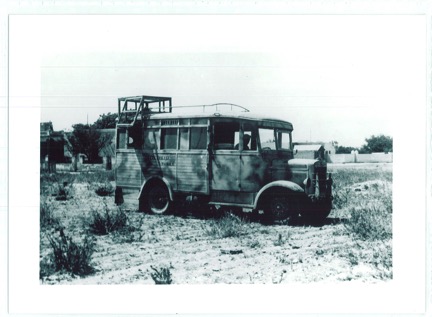
An Italian mobile loft, captured by us in Tunisia.

Not labeled.


Not labeled.

Not labeled.


This bomb fell on Hayes's  area.  Fortunately, it was a dud. 
Left to right:  Pvt. Gognon, Pvt. Cash, and Cpl. Roush.

When the projectiles and bombs started coming in, Sgt. Hayes and his crew dove into old German gun emplacements.  
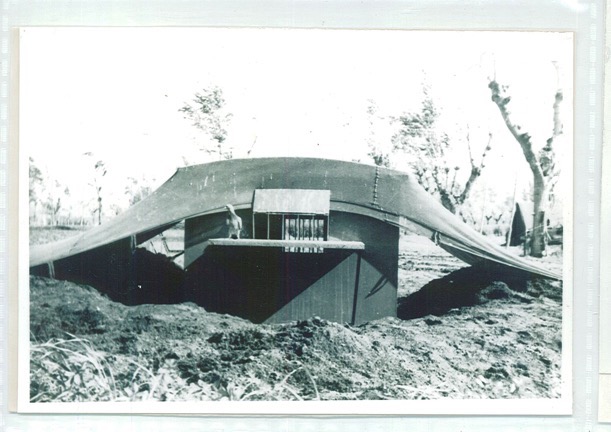
Camouflaged and half-buried loft at the Cassino front.

German War Bird doing the Goose Step.  Moments later this bird was shot down by American pigeoneers., Via Reggio, Italy.

The combat mobile loft of John Gangulio and Walt Haid in the Futa Pass, Northern Italy.


Yank
 
WWI 3rd Army
Lt. Ericson and Lt. Buscall, Tebessa
French pigeons, Algiers
Camels
British pigeons, Carthage
Mark VI Tiger Tank
Not labeled
Not labeled
French pigeons, Algiers


L to R:  Anthony Scurti, Cletus Moert, and Dapper Dan Martinovich, handlers of the pigeon, Yank, at the Tebessa front, Northern Algeria.
 
Sgt. Steinhaus, loft rear, just returned for repairs from the Anzio front, San Prisco, Italy.  (Notice the shrapnel holes in the loft.)


Herman Williams, co-trainer of the pigeon named Capt. Fulton, examining the wound in the head of his pigeon suffered while carrying a message from the front at Sessa, Italy.
 
Pigeoneers and combat mobile lofts on the deck of a landing craft during the invasion of Italy at Salerno.


The Italian loft the Allies captured in Genova, Italy, a British major in the foreground.  The loft was three stories high with its watch tower station on top.


Is this a station?  Please email jspangler8@comcast.net if you can identify

 
Pigeon loft


Not labeled
 
Pigeoneers and mobile lofts

 
Lady Astor
 
Mobile loft


Two pigeons in foreground


Sgt. Hayes, co-trainer of the pigeons Old Seventeen, Rain-in-the-Face, and Hawk Bait, feeding his pigeons at the beach, La Spezia, Italy.  Photo also found in The Pigeons That Went to War.

Photo not labeled

The Last Round-up:  All combat mobiles back from the field, our last meeting on the bank of the Adige River, Italy.  Photo also found in Hayes’s book The Pigeons That Went to War.


Leonard Karnopp holding the freak pigeon with three legs.  Bizerte, Tunisia.  Hayes writes that The Freak was a great flier and much loved by the pigeoneers.
The main breeding base at San Prisco, Italy.
                                                            Photo not labeled.

Photo not labeled.
Half-buried, a camouflaged combat loft at the Anzio beachhead, Italy.

The combat mobile loft of John Gangulio and Walt Haid in the Futa Pass, Northern Italy.


Saturday, April 25, 2020

Reorganization of Middle East Pigeon Service after victory at El Alamein, 1942

Mersah Matruh is Captured, November 11, 1942
Original wartime caption: A large German seaplane found wrecked in Mersa Matruh harbour, with sunken ships in the harbour behind.  Photo taken by No. 1 Army Film & Photographic Unit. Imperial War Museum © IWM E 19336

Picture of Fighting around El Alamein, 1942
Original wartime caption: Italian dead, burnt black by the desert sun, are here seen after the recent fighting South of El Alamein.  Photo taken by No. 1 Army Film & Photographic Unit.  Imperial War Museum © IWM E 14630

To see more photos from the Imperial War Museum, please visit iwm.org


(c) Crown copyright images reproduced by courtesy of The National Archives, Kew, UK

Catalog numbers:  AIR23/997  #11, #14, #18


Sunday, April 12, 2020

Pigeons deliver 884 messages in first year of Middle East Pigeon Service, 1943; Bletchley Park short film


(c) Crown copyright images reproduced by courtesy of The National Archives, Kew, UK
Catalog numbers:  AIR23/998  #146, #147, #148, #149, #150
The scroll bar at the bottom of the screen allows you to center the report and read the full page.

The Bletchley Park newsletter is full of interesting things to do online, including a code breaking challenge!  To subscribe, you can visit the website, www.bletchleypark.org.uk
Here is a description of the film from the Bletchley Park newsletter and a link to the film you can copy and paste to your browser:

The Hidden Film


Watch our latest documentary on YouTube to discover the story behind a silent film recently donated to the Bletchley Park Trust.

The footage shows members of MI6 Section VIII at Whaddon Hall in Buckinghamshire and is believed to be the only known wartime footage of any site linked to wartime Bletchley Park.

https://www.youtube.com/watch?v=MNdPmBqMh_Y


Saturday, March 28, 2020

"Unlikely Allies" by Chuck Oshaben: A story about crows and young pigeons


This article was published in Racing Pigeon Digest, Vol. 28, No. 20, March 15, 2020.  It appears here courtesy of the author, Chuck Oshaben, and the Editor/Publisher of Racing Pigeon Digest, Gene Yoes.  You can send correspondence for Mr. Oshaben to chuckoshaben@gmail.com and for Racing Pigeon Digest to pigeondigest@gmail.com.

The question people ask me most often about the war pigeons is, “How did they find their way back?”  Chuck’s story gives us a look into the bird world. His story is a testament to birds’ intelligence and to how well they understand us and therefore it offers some insight into why the war pigeons would risk their lives over and over again to deliver messages for their human friends.  

The pages are depicted in two sizes.  For the larger size you can use the scroll bar at the bottom to move the page into full view.


Sunday, March 15, 2020

Middle East Breeding Centre and School, 50 pigeons needed at Aden,1943, and talk about Enigma by Dermot Turing, 2020

Royal Air Force Operations in Middle East and North Africa, 1940-43
Armoured cars and vehicles rest on the track between Lahej and Musemir in the mountains of Southern Arabia, during a reconnaissance patrol by the RAF Armoured Car Section, based at Khormaksar, Aden.  Photo taken by RAF Official Photographer.  Imperial War Museum  © IWM (CM 5249)

(c) Crown copyright images reproduced by courtesy of The National Archives, Kew, UK
Catalog numbers:  AIR23/998  #138, #139, #144

On February 13, 2020, Alan Turing’s nephew, Dermot Turing, gave a talk about his latest book X, Y and Z, The Real Story of How Enigma Was Broken at the International Spy Museum.  You can listen to the talk on the C Span 3 website.  Search Dermot Turing in the search box near the top of the home page.  This will take you to the page where you can click on the blue play button next to “Breaking the German Enigma Code.”  The talk includes questions and is about 98 minutes long. Turing does an excellent job of giving the Poles the credit they deserve for their contribution to breaking Enigma.  Sadly, the talk was given on the 90th anniversary of the death of Christopher Morcom, Alan Turing’s brilliant and inspirational friend. They met in 1928 at Sherborne School.  Christopher died unexpectedly on February 13, 1930.  To learn more about their friendship, check out the documentary Codebreaker releasd in 2012.
Below is a link to the talk:


Sunday, March 8, 2020

50 lofts needed in East Africa and Pigeon Loft 271 to serve Bombers USAAF, 1943

(c) Crown copyright images reproduced by courtesy of The National Archives, Kew, UK
Catalog numbers:  AIR23/998
#121, #122, #123, #134, #135, #136, #132, #131, #130, #128, #124

NOTE:  Yesterday, March 7, marks the 75th anniversary of the Allied capture of the Ludendorf Bridge across the Rhine.  For an account of this operation, check out “Hitler’s Last Bridge,” an episode of the TV documentary World War II’s Greatest Raids, produced in 2014.


Supply of Pigeons from South Africa and Establishment of Lofts for Middle East Pigeon Service, Jan-Mar 1943

The Royal Air Force East Africa Command, 1940-45
Bombs explode among Italian Caproni Ca 133s on 'K14' satellite landing ground at Assab, Ethiopia, during a raid by Bristol Blenheim Mark Is of Nos. 8 and 39 Squadrons RAF, based at Khormaksar and Sheikh Othman, (respectively), Aden. Three Ca 133s were destroyed and one damaged.  Photo by No. 8 Squadron RAF.  Imperial War Museum  © IWM (CM 2)
No date available for photo

(c) Crown copyright images reproduced by courtesy of The National Archives, Kew, UK
Catalog numbers in the order in which they appear:  AIR23/998
#118, #119, #120, #116, #110, #111, #112, #113